Spring Marlborough • Show Stoppers
The Paradise City Arts show in Marlborough, Massachusetts showcases 170 of the “best-of-the-best” of America’s most exciting independent artists, designers and master craft makers. This March, dozens of remarkable artists were selected to exhibit here for the very first time.
We are pleased to welcome a fresh crop of exhibitors to the show. From those artists participating in Paradise City Arts Marlborough, we have selected five as our Show Stoppers. Please welcome these five and dozens of artists to Paradise City Arts this spring!
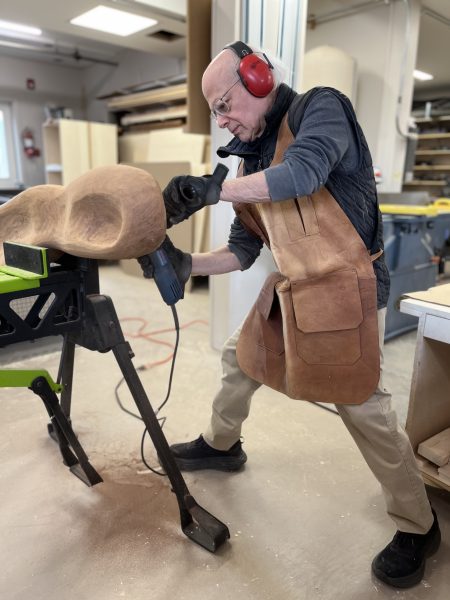
Based in Marblehead, Massachusetts, Michael Weiss is a sculptor and master woodworker who has spent over four decades translating the physical world into intuitive, visual forms. With degrees in sociology and modern art from Brandeis University—where a deep dive into Jackson Pollock and Abstract Expressionism first sparked his creative liberation—Weiss has spent his career mastering the balance between the “right-brain” joy of creation and the technical precision of high-end architectural woodwork.
For twenty years, Weiss led award-winning projects in libraries and kitchens throughout greater Boston, but his current practice represents a powerful “reimagining” of his role. Today he focuses on furniture, furnishings, and abstract sculpture that explore the interplay of line, space, and spirit. His work, such as the Holding Space dining table, reflects a belief that space is never empty, but rather filled with energy and movement.
“For me, so much of the world is visual, intuitive, and physical,” Weiss notes. “Ingenuity is its own reward.”
Inspired by the fractal patterns of winter trees and the stillness of the New England coast, Michael leads a collaborative team of artists at his Marblehead workshop. Whether he is designing a live-edge lamp or a transitional entry-hall mirror, his work seeks to facilitate a graceful flow of energy between human beings and their environment.
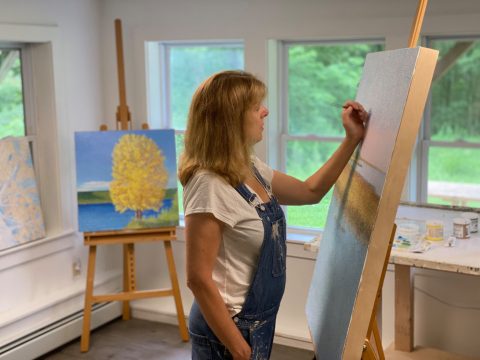
Valerie Romano is a master of contemporary pointillism, creating luminous New England landscapes through a meticulous, “one dot at a time” process. Now based in Meredith, New Hampshire, Valerie’s work is a sophisticated fusion of technical precision and impressionist soul, blending the structured technique of Georges Seurat with the vibrant, expressive palette of Claude Monet.
With a dual background in Studio Art and Graphic Design, Valerie’s career has spanned from technical textbook illustration in New York City to a position as an illustrator at Boeing. This foundation in accuracy informs her current creative process: working on prepared hardboard, she utilizes a size 0 brush to build layers of rhythm and texture. The result is a meditative study of light and the feeling of place across the New England wilderness—from the iconic white birch to the intricate reflections of Lake Winnipesaukee.
“Every dot of paint is placed individually,” Valerie says of her method. “I seek to merge technical precision with the emotional resonance of color and light.”
A profound turning point in Valerie’s life occurred during her time in New Mexico, where she worked with SaveTheChimps and was encouraged by Jane Goodall to “follow her heart.” This ethos of purpose continues today; Valerie volunteers her time teaching painting to visually impaired students, ensuring art remains accessible to all.
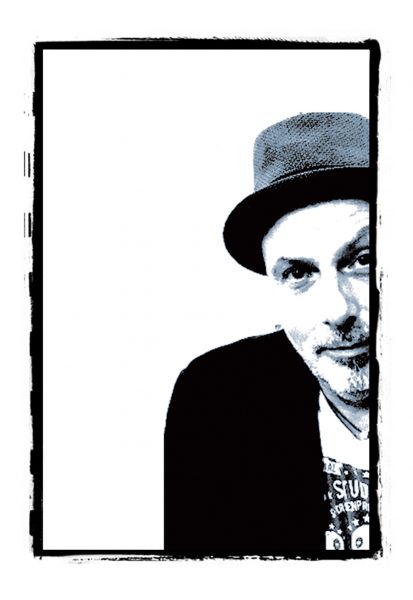
Operating out of a historic brick mill in Pawtucket, Rhode Island, James Polisky creates hand-printed silkscreens that bridge the gap between fine art and subversive social commentary. A former professional drummer who once opened for the Rolling Stones, Polisky traded his drumsticks for squeegees twenty years ago, finding that the “instant feedback” of a visual connection with an audience mirrored the electric energy of a live performance.
Polisky’s work is a defiant stand for the handmade. In an era of digital reproduction and AI, he remains committed to the physical ritual of the craft: sketching by hand, exposing photo emulsions, and mixing custom inks for every layer. While his creative background includes roles in darkrooms, graphic design, and wallpaper color separation, his true voice emerges in the “diary” of his prints—a world where humans and animals intertwine through a lens of humor, satire, and brutal honesty.
Recently, Polisky’s evolution has moved toward larger, one-of-a-kind layered pieces that incorporate collage, spray paint, and varnish. Whether he is tackling a poignant political message or a low-brow joke, his work remains a deeply personal exploration of modern life.
“Inspiration surrounds us every day,” Polisky says. “Between life and death, there is a lot to inhale. The trick for me is staying open to it—the willingness to acknowledge and embrace it.”

For Kathleen Tesnakis, fashion is a form of environmental activism. As the founder of ekologic, Kathleen has spent the last three decades transforming the global textile waste stream into high-end wearable art. Operating out of a transformed historic church in Troy, New York (fittingly dedicated to the patron saint of seamstresses) she has personally reclaimed over 18 tons of post-consumer wool and cashmere, diverting it from landfills to create more than 44,000 one-of-a-kind pieces.
Kathleen’s “Ah-Ha!” moment arrived thirty years ago when she discovered that 99% of used textiles were discarded. Drawing on a Bachelor of Science in Textiles from Syracuse University and her experience as a designer for Scalamandré Silks, she developed a proprietary circular design system. Her process is a rigorous “alchemy of recycling”: she hand-selects discarded garments, then washes, felts, de-lints, and collages the fabrics using five different specialized sewing machines to elevate every seam into a bespoke design statement.
Inspired by an upbringing in India filled with opulent colors and textures, Kathleen views the randomness of the waste stream as a “material generator.” Ranging from artful hats and mittens to sculptural clothing, her work celebrates the integrity of natural fibers and the unique character of the people who wear them.
“I believed that a simple item, such as a recycled hat, could lead to conversations that change the world,” Kathleen says. “Thirty years in, I know it can.”
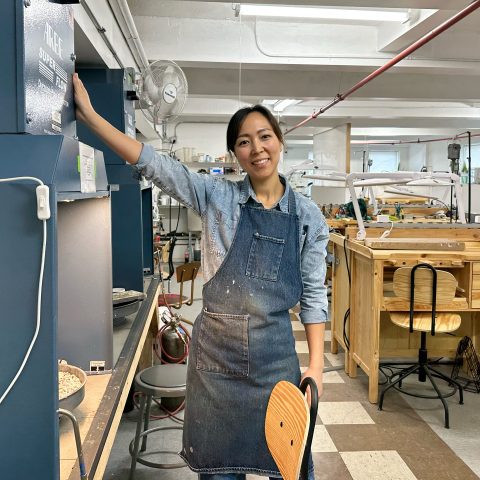
Based in the creative hub of Long Island City, Queens, Jinbi Park creates jewelry that serves as a bridge between the precision of gemology and the fluid, organic forms of the natural world. Raised in the coastal city of Busan, South Korea, Jinbi’s path to artistry was paved by early memories of her grandmother’s painting studio and a lifelong fascination with the ocean. Drawing on her experiences as a scuba diver, she translates the “ever-changing dance of light” and the rhythmic movement of marine life into three-dimensional wearable sculpture.
Jinbi’s career is defined by an elite technical pedigree. After earning a degree in Tokyo and her GIA Graduate Gemologist certification, she moved to New York to study jewelry design at the Fashion Institute of Technology (FIT). Over the past 14 years, she has evolved from a diamond industry professional into an independent artist, meticulously hand-fabricating each piece to ensure every texture and stone setting reflects her personal vision.
Beyond her studio practice, Jinbi is a dedicated educator, serving as an adjunct instructor at FIT and teaching high school jewelry arts on Long Island. Her award-winning designs have been exhibited in museums in Italy and galleries across New York, capturing the fragile beauty of marine life through sustainable materials and masterful craftsmanship.
“I’m fascinated by themes of organic growth and movement,” Jinbi explains. “My jewelry is a reflection of the intricate forms found underwater—a way to translate the beauty of the ocean into a gesture of memory and design.”
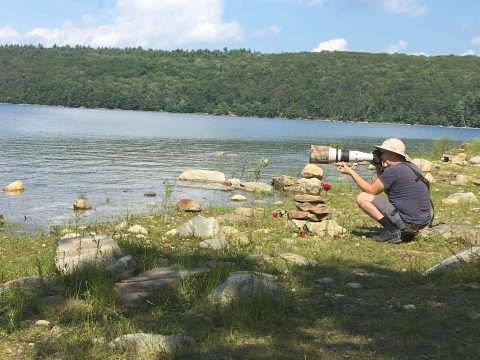
For Joe Oliverio, the studio has no walls. While his editing and printing take place in Amherst, Massachusetts, his creative process unfolds across the diverse natural habitats of the Pioneer Valley. As a longtime musician and social justice advocate, Joe’s path to photography was born from a life of observation. Originally picking up a camera to document political campaigns and help his partner’s grandparents identify birds in national parks, he soon discovered a vibrant world that had previously been unknown to him.
Since 2013, Joe has evolved from capturing “cool, colorful birds” to becoming a passionate conservationist. This transition has redefined his work as an ethical practice; he prioritizes the health of his subjects and their environments above all else. His style is deeply influenced by the intentionality of classical composition, where every pixel serves to complement the subject. By shooting at first light to avoid heat distortion and harsh shadows, Joe captures the intricate interplay between a bird’s plumage and the textures of its habitat—the berries, flowers, and seasonal rhythms that define its life.
Joe’s commitment to the local landscape is legendary among the New England birding community. In 2018, he made headlines by identifying the first-ever Pacific Slope Flycatcher recorded in Massachusetts. Currently, he is engaged in a years-long “300 species” quest within Hampshire County—a feat of patience and dedication that mirrors the meticulousness of his photographic prints.
“At almost 50, I began to see details in nature that I had been oblivious to,” Joe reflects. “My work has evolved into an ever-deepening understanding of our connection to nature.”