Northampton May Show Stoppers
The 200+ artists + makers who are accepted to participate in the Paradise City Arts Festival in Northampton on Memorial Day Weekend are the “best-of-the-best” of America’s independent painters, sculptors, and craft makers from every corner of America. Each season, Paradise City introduces many exciting new artists who will exhibit their work in the Northampton show for the first time.
We are pleased to welcome a fresh crop of brand-new exhibitors to the show. From those artists making their Paradise City Northampton debuts, we have selected six as our Directors’ Picks. Please welcome these six and dozens of new artists to Paradise City Northampton this spring!
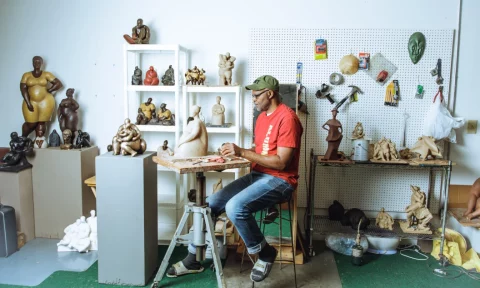
Sculptor Nnamdi Okonkwo lives and works in Fayetteville, Georgia, just outside Atlanta, where he has created figurative sculpture full-time for decades. He knew he was meant to be an artist at 17, a calling encouraged by his mother, a rare gift in his Nigerian upbringing.
Okonkwo studied art from an early age, earning a bachelor’s degree in painting before completing additional degrees, including an MFA in sculpture. Since graduating in 1997, he has remained devoted to his practice. His work centers on the human figure, particularly the female form, exploring what he describes as the nobility, grace, and quiet divinity of the human spirit.
Working intuitively in clay or wax, Okonkwo allows each form to emerge naturally before casting the finished piece in bronze, a material he values for its strength and permanence. “Sometimes my work starts with a sketch,” he says, “other times I just immerse my hands in clay or wax… and wait with excitement to see where my hands take me.” His sculptures appear in museum collections, private holdings, and public spaces worldwide. For Okonkwo, sculpture is both devotion and discovery, giving timeless human presence physical form.
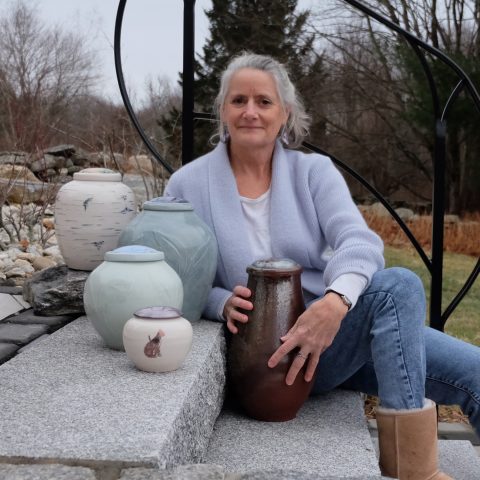
Sherie Gage works from her home studio in Columbia, Connecticut, creating materially rich vessels under the name Cone 6 Designs. A second-generation artist raised among both art and science, Gage arrived at her studio practice through a long, layered path. After 15 years as a nurse while raising a family, she completed her BFA in Ceramic Sculpture at the University of Connecticut in 2008 and has been a committed working artist ever since.
Gage spent years exploring ceramics and vitreous enamel on copper as separate disciplines before discovering the power of bringing them together. “Glaze is glass formulated to fire onto ceramics, and vitreous enamel is glass formulated to fire onto metal,” she explains. “I found a new challenge and passion by combining enamel and ceramics together as a unified whole.” Her signature pieces pair porcelain urns with hand-hammered, enameled copper lids that must physically engage and visually harmonize.
Inspired by birds, insects, flowers, and trees, Gage’s process balances discipline and intuition. Each piece unfolds through multiple firings and careful handwork, resulting in vessels that are both functional and deeply meaningful. As an artist making urns, Gage hopes “to provide some small amount of comfort to those who are experiencing pain and looking for meaning after loss.” Through Cone 6 Designs, her work honors memory through material, process, and care.

Jamie Malcolm-Brown thinks of the outdoors as his studio. Based in New England, he works primarily in the Pioneer Valley while traveling throughout the U.S. and abroad. What began as a way to document post-college work travel evolved into a deeply intentional photographic practice shaped by patience, weather, and light.
Malcolm-Brown bought his first SLR in 2002 and taught himself photography over the next two decades. After years photographing events, weddings, and nature, the artist explains, his focus “shifted from documenting scenes to intentionally seeking moments shaped by weather, light, and timing.”
Fog, storms, night skies, and fleeting conditions are central to his images. A pivotal moment came during a foggy sunrise, when he saw how mist softened backgrounds and isolated his subject. His process is grounded in research and return – scouting locations, tracking weather patterns, and revisiting places until conditions align.
Using long exposures, focus stacking, night photography, and occasional aerial views, Malcolm-Brown creates calm, intimate images that invite viewers to slow down and experience the quiet relationship between land, light, and time.

Mihoko Wakabayashi is a fiber artist who works from her studio in Worcester, Massachusetts, where weaving is both a personal practice and a way of bringing people together. With more than 30 years of experience, her work is rooted in SAORI weaving, a Japanese freestyle philosophy that celebrates individuality, spontaneity, and the beauty of imperfection.
Originally trained as an educator, Wakabayashi taught in alternative schools in Tokyo and later at Japanese schools in Detroit and Boston. After returning to the U.S. in 2000, she recognized SAORI weaving as a powerful tool for connection and opened her first studio at home. That spirit of accessibility continues to guide her practice today.
“I started weaving in 1992, learned spinning in 2005, and learned indigo dye in 2016,” she says. Over time, she has combined these disciplines into a deeply intuitive process, sometimes dyeing fleece to spin, other times dyeing yarn or even weaving fabric first and dyeing it afterward. “It all depends on the material I get and work spontaneously,” she explains, with some pieces traveling the full journey from “sheep to shawl.”
Wakabayashi practices freestyle weaving across all aspects of her work. “I try not to have a specific goal or finished product in mind when I start,” she says, instead embracing experimentation, trial and error, and the unexpected. Nature remains her constant inspiration: “I feel like walking in a summer field or snowy mountain while weaving.” Grounded in a beginner’s mind, her textiles and garments are made to surprise—bringing smiles, warmth, and happiness to those who wear them.
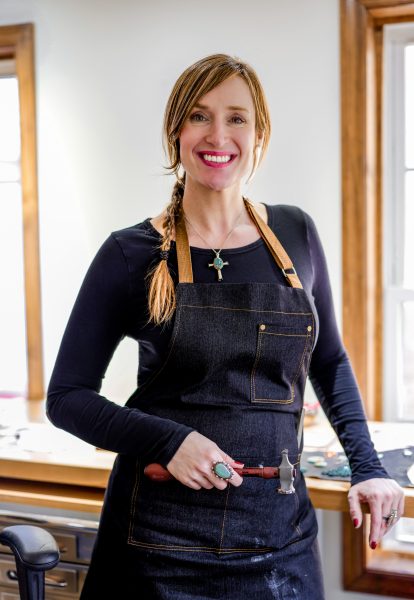
Jeweler Marie Murphy works from her home studio in Madison, Connecticut, where forest meets shoreline, a quiet intersection that shapes the balance, texture, and strength of her work at Silver Raven Studio. Drawn to stones from an early age, she grew up collecting beach rocks along the Massachusetts coast and learning, through her mother’s jewelry collection, that well-made pieces are meant to be worn, lived in, and passed along.
Murphy began metalsmithing in the early 2000s and founded Silver Raven Studio in 2014. Her education has been hands-on and ongoing, built through workshops, years at the bench, and experience as a buyer, production assistant, and vintage jewelry curator. That background instilled a deep respect for traditional craftsmanship and sound construction.
Today, Murphy is focused on creating “statement jewelry but also pieces that carry meaning and connection.” She wants her work to feel “personal, wearable, and integrated into everyday life rather than reserved for special occasions.” For her, jewelry is more than adornment: “It carries energy, connection, and intention,” and being present with both the work and the people who collect it is part of that exchange.
Each piece begins with a stone. Murphy spends time with the material first, allowing its character, color, and presence to guide the design. From there, she builds a solid foundation in heavy-gauge sterling silver, relying on traditional metalsmithing techniques and a careful, unhurried process. Designed for daily wear, her jewelry is made to age beautifully- pieces meant to last, gathering meaning, memory, and personal history over time.

Kibaek Sung is based in Bellingham, Massachusetts, where he creates hand-fabricated metal objects that live between function and expression. He began working with metal in 2005 while in college, earning a Bachelor’s degree in Metal Craft in South Korea in 2009, followed by a Master’s degree in 2015. After moving to the United States, Sung completed a second Master’s degree in 2019. Alongside his independent studio practice, he works as a silversmith at Tiffany & Co., refining his skills through traditional techniques and meticulous hand construction.
“My work has always been about balancing function and aesthetics,” Sung says, “but over time I’ve become more interested in approaching that balance in a playful way.” Early in his career, he imagined following a more academic path, but moving to the U.S. exposed him to a broader range of experiences and approaches. “That naturally pushed me to expand my practice and explore new directions,” he explains.
Sung draws inspiration from nature, simplicity, and everyday observations, combining pure, essential forms with a sense of joy and play. Movement often becomes central to his work, acting as a bridge between object and viewer. “I’m especially interested in movement, interaction, and how people experience objects,” he says, relying on traditional metalworking techniques and hand fabrication to bring those ideas to life.
For Sung, the pleasure of making lies as much in the process as in the outcome. “The process of finding an idea and figuring out how to make it real is just as important, and enjoyable, as the final piece.” Created to be handled rather than simply observed, his objects invite curiosity, touch, and quiet moments of surprise, offering small but meaningful connections in everyday life.